Case study · Human–robot interaction
Component-based motion design for a care robot
Lemmy is a two-wheeled companion robot for older adults. Without human-like gestures, its motion carries much of what it communicates. This research asks how that motion should be designed, and who should inform it.

Overview
Designer and researcher, first author
IID Lab, UNIST, with U. V. U. Ismatullaev and Prof. KwanMyung Kim
2024 – 2025
Designer workshop, expert interviews, paired-comparison study, validation study, thematic analysis
6 designers in the workshop, 25 adults aged 65+ for preferences, 15 more for validation
KSDS 2025, IASDR 2025, and a CES 2025 Innovation Award with the Lemmy team
Co-design with older adults is valuable, but long sessions are tiring and difficult to repeat. Robot motion is typically settled late, by intuition, once hardware exists. This work instead elicits preferences once for a small set of motion components, and composes new actions from them.
Three gaps in robot motion design practice
-
1
Theory rarely becomes method
Established frameworks describe expressive motion, but few provide step-by-step processes a designer can follow.
-
2
Intensive co-design burdens older participants
Cognitive load, fatigue and unfamiliar technology make intensive co-creation sessions with older adults difficult to sustain.
-
3
No validated reusable components
No validated method existed for decomposing an action into parts that can be tuned once and recombined into new actions.
A four-stage method from action ideation to validation
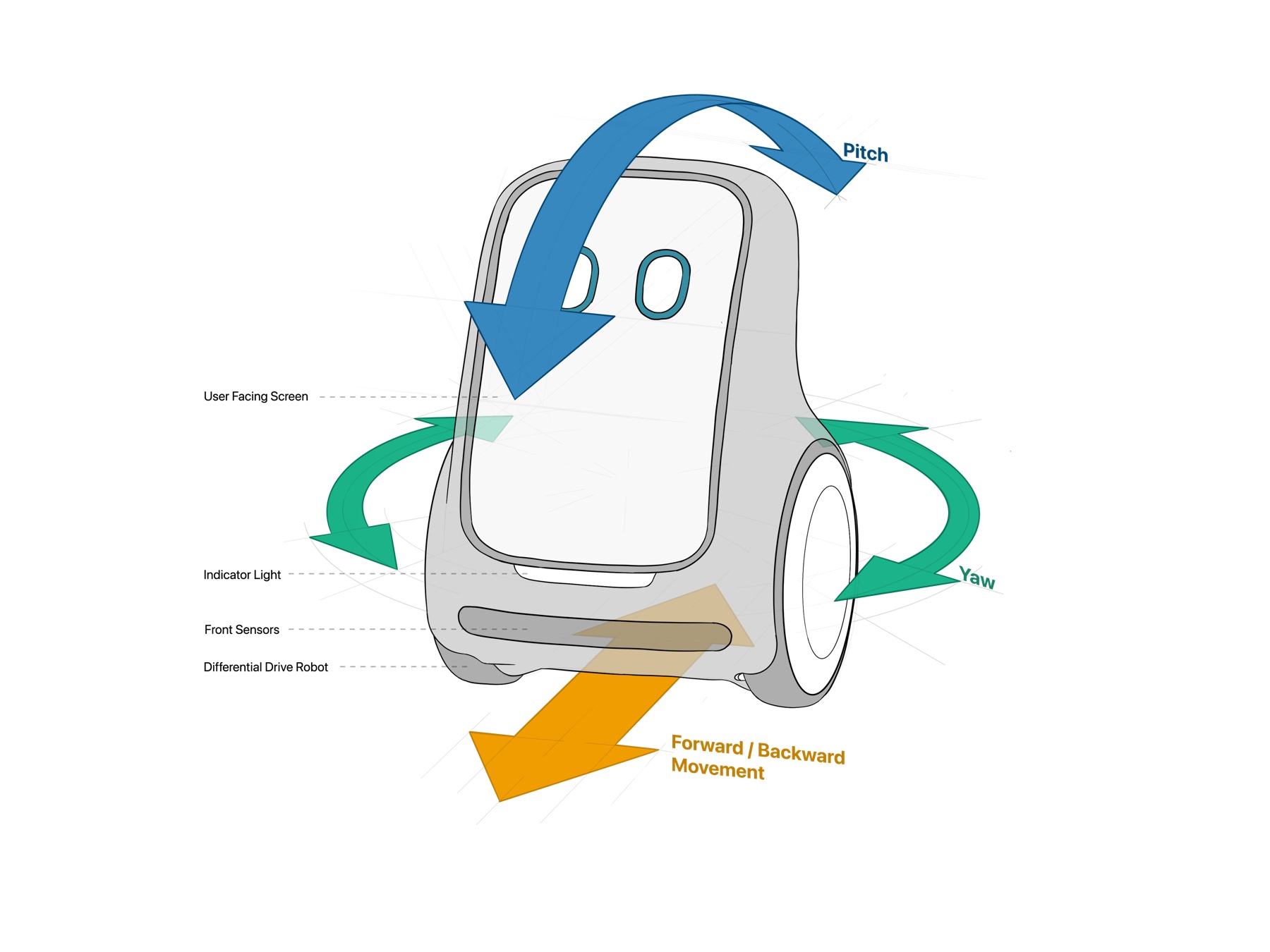
All studies used a high-fidelity digital twin: Lemmy’s CAD model, imported into Blender and animated strictly within the robot’s physical limits. This enabled rapid iteration, full control of variables, and studies conducted while the hardware was still in development.
Step 1 · Action catalogue
A 22-action catalogue from a participatory workshop
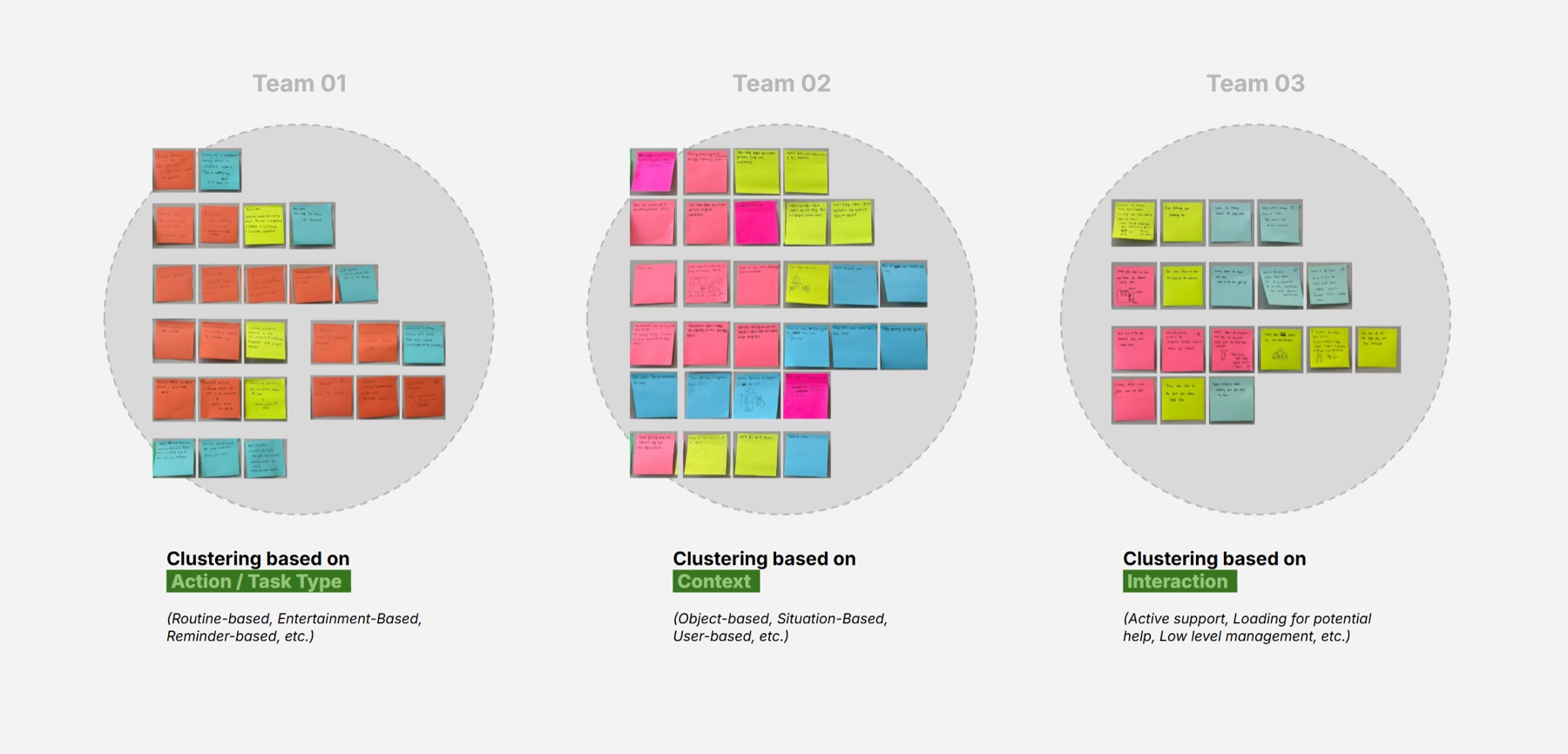
I ran a participatory workshop with six designers in three teams. Working from everyday scenarios, such as an older adult preparing breakfast or searching for a misplaced item, the teams listed each moment where Lemmy could assist, then clustered the ideas.
The teams generated more than 40 action ideas, consolidated into a catalogue of 22 actions: 14 functional and 8 expressive. Five appeared in every team: approach the user, follow, return to dock, reposition and nod.
Step 2 · Components
Four motion components identified through expert interviews
Interviews with professional designers revealed how they reason about motion: the variables they adjust and how they decompose an action. Four components were both practical to design with and readily perceived by older adults.
- Speed
- Path
- Posture
- Turn type
Thematic analysis also identified rhythm, repetition and acceleration, which were set aside to keep the tests simple.
Step 3 · Preferences
Paired-comparison preferences from 25 older adults
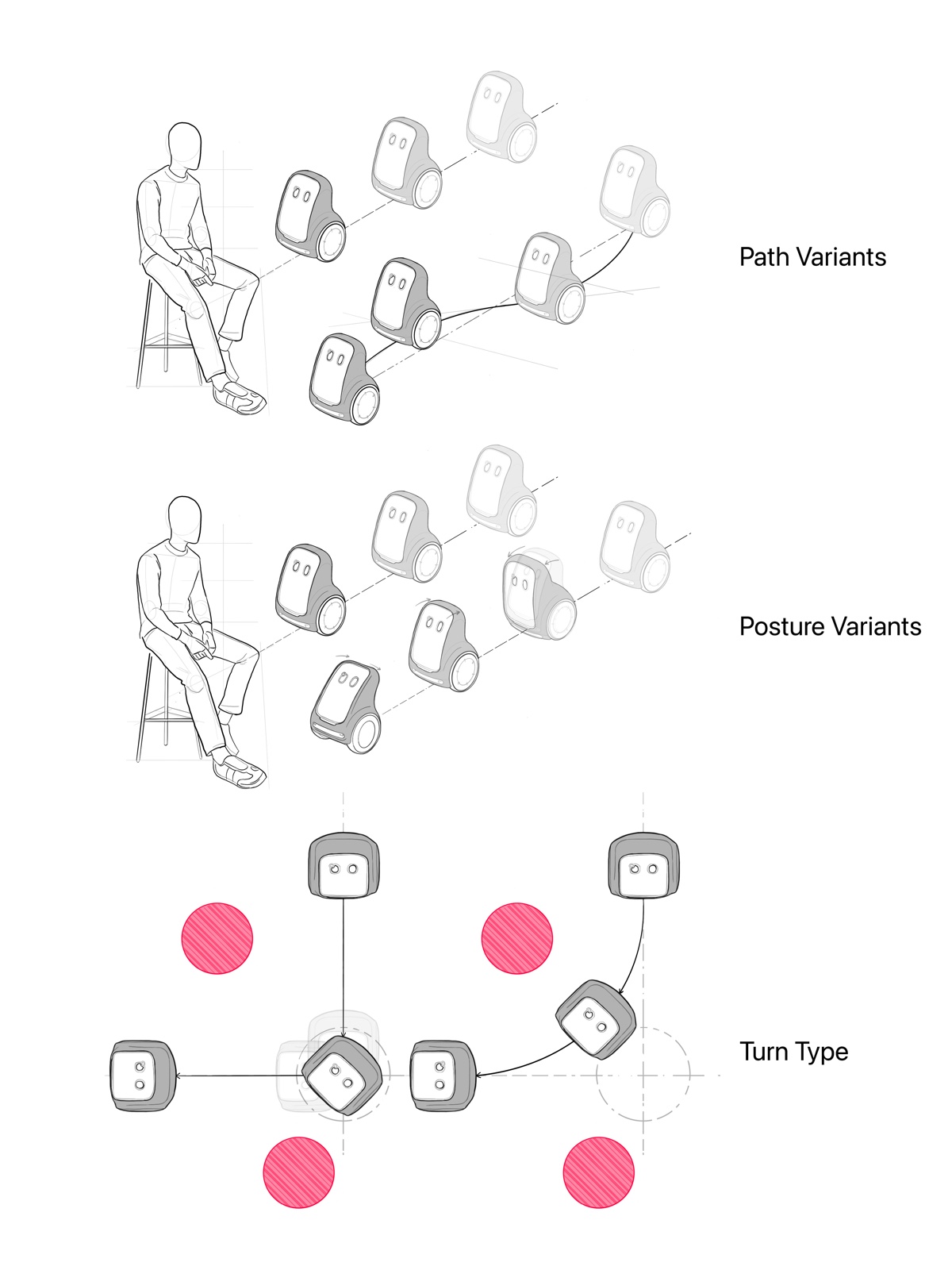
Twenty-five adults aged 65 and over, all in Pakistan, viewed pairs of 3D animations that differed in a single component and selected the one they preferred. Trial order was randomized.
- Speed: normal (about 0.5–0.7 m/s, a small pet’s walking pace) or fast (over 0.7 m/s)
- Path: straight or gently curved
- Posture: upright and static, or leaning with the action
- Turn type: a sharp pivot or a smooth arc
Step 4 · Validation
Validating preference-based actions with a new sample
Three actions (approach the user, return to dock and a dance) were each built in four variants:
- V1 from the preferred components
- V2 from the non-preferred ones
- V3 and V4 from random mixes
A new group of 15 older adults, with no exposure to the component tests, rated each of the 12 videos out of 10 and explained their ratings.
Preferred components produced the highest-rated actions
Component preferences of older adults
Share of 25 participants choosing each variant
Posture, path and turn-type preferences did not reach statistical significance in this sample and should be treated as directional. Together they define a default motion profile for Lemmy: moderate pace, straight paths, smooth turns and a body that leans into the action.
Ratings of complete actions
Mean score out of 10 from 15 new participants
Preferred components scored highest overall. Across all actions, V1 received the highest mean rating with the narrowest spread (95% CI 7.24–8.10). Non-preferred assemblies scored lowest for every action.
Legibility matters most when the goal is clear. “Return to dock” built from preferred components received the highest score (SD 0.88), with a confidence interval that overlapped no other variant.
Expressive actions tolerate more variation. For the dance, a random mix scored close to the preferred version, and ratings were more divided.
Implications for robot motion design
Preferences elicited once can be reused across actions
A small library of preferred component values serves as a design prior. New actions can be composed from it, and only deliberate departures require further testing. This conserves participants’ time, a scarce resource in eldercare.
Predictable motion for tasks, more latitude for expression
Straight paths and smooth turns matter most for task actions, where people must read the robot’s intent. Expressive actions such as dancing can relax these constraints without reducing acceptance.
Motion can be evaluated before the hardware exists
Animation bounded by the robot’s physical limits allowed motion to be studied while the prototype was still in development, without tying design decisions to the hardware’s interim capabilities.
Limitations. Each component had only two variants to keep the tests tractable, so finer distinctions were not captured. Animation cannot reproduce live timing, personal space or real reactions. Samples were small and drawn from a single country; embodied testing is the next step. Two of these limitations shaped the subsequent work: a tool that keeps animations physically feasible, and AR studies that place the robot at life size in real rooms.